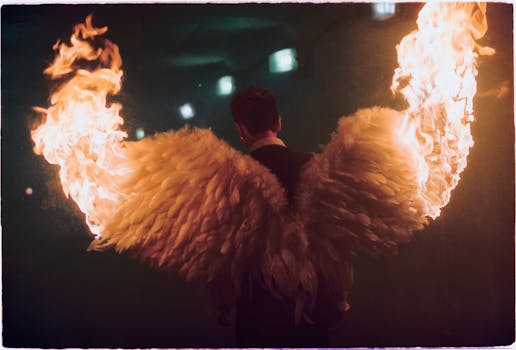
The untamed spirit of fire—that's our quarry. Conventional renderings fall woefully short; they miss the heart of the matter. Forget slavish mimicry of flames; we seek the visceral experience. Consider photography’s frozen moment versus abstract art’s immersive encounter. It's a chasm, a gulf.
Employ unconventional tools, I implore you. Imagine: crumpled, acrylic-drenched tissue, a watery mist coaxed from a spray bottle, then imprinted onto the canvas. This process yields an unpredictable texture—a perfect analogue for the fire's capricious nature. Embrace pouring techniques; let the pigments freely commingle, generating unforeseen configurations that echo the flames’ erratic ballet. Visualize the fiery heart of a sunset, a conflagration mirrored in vibrant hues—oranges, crimsons, and deep ochres. Layer these pigments, allowing them a tumultuous confluence. Don't strive for control; let colors clash and contend, much as your brushstrokes should. Revel in the glorious chaos!
Fire's dynamism is paramount. Banish meticulous lines; instead, unleash broad, frenetic strokes. A palette knife—that's your new ally—for building impasto textures, evoking fire's palpable presence. Dare to wield a blowtorch (with extreme caution!), scorching the canvas or paper. These aren't flames you're depicting, but the heat's very essence—a tangible expression of potent energy. Conjure the wind’s frenzied assault on the flames; let your brushwork mirror this chaotic energy. Your arsenal? Brushes of every size, sponges, even your fingertips. A dynamic composition demands a multiplicity of approaches. Layer techniques, materials, and let them dynamically inform one another. Every stroke must advance your abstract inferno’s narrative.
Think of color layering as constructing a bonfire. Every shade, every pigment layer contributes to the overall intensity. Deep, somber hues become the embers, the fire's fervent core, while radiant, light shades represent the flames' skyward aspiration. Explore diverse media. Acrylics intermingled with charcoal or pastels? Oils infused with metallic pigments for an ethereal luminescence? The possibilities are as boundless as the fire itself.
Negative space—a critical element. Observe how darkness enhances a fire's brilliance. Similarly, voids within your artwork amplify the painted sections' power. It's not merely what you paint, but equally, what you refrain from painting. Let the negative space breathe; let it heighten the fiery composition's impact.
In the end, your abstract conflagration must tell a story—a tale of raw emotion, fleeting beauty, and transformative energy. This is the essence, the very soul of the piece.
Unfettered by literal depiction, the allure of abstract art resides in its capacity to plumb emotional depths. Representing fire through an abstract lens compels a departure from its physical manifestation; instead, we delve into its metaphorical resonance. A crucible of passion, annihilation, rebirth, and purification – fire, a potent symbol, resonates with profound cultural and emotional weight. [Capturing this volatile energy through abstract techniques unlocks access to these layered meanings](https://www.britannica.com/art/abstract-art), translating the ethereal into a visual vocabulary of compelling eloquence.
Think of a musical score: it doesn't visually portray the music itself. Rather, it furnishes a skeletal framework, a blueprint, empowering musicians to breathe life into its emotional core and dynamic pulse. Similarly, your abstract artwork functions as a visual score, inviting the viewer to actively participate in its genesis. The viewer is prompted to engage intimately with the emotions you’ve channeled into chosen mediums and techniques. The intrinsic beauty inheres in this subjective, intensely personal experience. Objectivity evaporates; what remains is the sheer potency of self-expression, a testament to interpretative freedom.
Abstract fire possesses a raw power, precisely because it’s unbound by the shackles of realism. It transcends mere representation, liberating itself from the confines of portraying the 'thing' in itself. This affords a fertile ground for experimentation, a playground for improvisation. The heart of the matter is capturing the very essence, the feeling of fire. Envision this creative process as sculpting with light and shadow. Forget the meticulous replication of flame; instead, masterfully manipulate light and color, shape and form, conjuring an evocative, resonant impression.
The creative journey itself—the process of crafting abstract fire art—holds equal, if not greater, significance to the final piece. It's a meditative sojourn, an opportunity for profound introspection, a release of uninhibited emotion. Each brushstroke, each meticulously applied layer of pigment, each textural element emerges as an outward manifestation of your inner world. It's cathartic, a method for expressing the inexpressible – the sentiments that elude the limitations of language. The act resembles building an ephemeral sandcastle; the very creation is a voyage, an experiment, a spontaneous dance of creativity. The resulting artwork often proves a transient delight, a fleeting testament to unbridled imagination and fluid expression, a testament to the journey itself which elevates it beyond simple representation. That journey is the very soul of artistic endeavor. [The inherent value of this exploration](https://www.moma.org/collection/works/3747) transcends the creation of a visually stunning artwork; it unlocks the dormant potential within you, fostering a deeper connection with the primal beauty and awe-inspiring power of nature's elemental forces. Abstract expression becomes your conduit, harnessing the untamed energy of fire, channeling its dynamism, its searing intensity, its evocative power onto your canvas, resulting in a truly unforgettable, and uniquely personal artistic statement. If you're interested in learning more about harnessing the power of color and texture, check out our guide on [how to draw fire](/how-to-draw-fire). For those looking to explore other mediums, you might find our guide on [how to make bronze statues](/how-to-make-bronze-statues) interesting. And for a completely different creative outlet, explore the relaxing power of [how to braid](/how-to-braid). Additionally, for those who want to explore different approaches to artistic expression, consider checking out our guide on [how to draw people](/how-to-draw-people) or learn [how to draw a snowflake](/how-to-draw-a-snowflake) for intricate detail. [Abstract art often uses unconventional techniques](https://www.khanacademy.org/humanities/art-history/early-20th-century-art/abstract-expressionism/a/abstract-expressionism) to evoke emotion and energy.